
First base is a pride position. First base is a guts position. As the father of a middle infielder, nothing drives me crazier than an infielder making a stellar play, throwing the ball low to first (as I teach them), then the first baseman waves at it, trying to “pick” it and the infielder gets the error.
To significantly improve a first baseman's stretch and overall infield productivity, a key drill involves having the player place both feet on the bag, stretch as far as possible, and mark their maximum glove reach. The first baseman then practices catching balls thrown softly at that precise spot, ideally 20 times per practice from 30-40 feet away. This consistent training helps first basemen catch more balls in the air and handle challenging short hops, thereby reducing infield errors, a technique advocated by CABA world champion baseball coach Bruce Lambin.
In Youth League ball, the better athletes play pitcher, shortstop and catcher. The little guy with the weak arm is at second and the slow guy that can throw it all the way across the infield plays third.
Then there is the first baseman (unless your stud left-handed pitcher also plays first). The further you go in baseball the first baseman slides further down the athletic scale. By the time you get to pro ball, in the vast majority of cases, the first baseman is the least athletic player on the field.
Very little time is spent on attempting to improve the first baseman’s skills. If you watch infield practice the first baseman invariably makes very little effort to “pick it.” They come off the bag on anything that isn’t right to their chest.
If you want to improve your infield productivity, spend some time challenging the first baseman to have some pride and guts and vow that “nothing is going to get by me! I will catch everything”!Then drill him!
Have him place both his feet on the bag and stretch as far as possible (keeping his throwing side foot on the base). Then have him reach out as far as possible and make a mark with his glove. Get back 30-40 feet and throw balls softly at that spot (with younger players, I suggest you use Incrediballs to overcome any fear factor). Have him begin each drill with both feet on the bag and stretch out as far as possible to either catch the ball in the air or “pick” it. Do this drill 20 or so times each practice and I assure you his legs will be quivering and, more importantly, your defense will improve immensely.
First basemen will catch almost all balls they reach in the air. They will catch many, if not most short hops, and the long hop is not difficult. It is the in-between hop that is tough. If they discipline themselves to stretch, they take away the difficult “tweener,” catch more in the air, and handle the short hop.
Bruce Lambin raised and coached two talented T-Ball players who became the best baseball players they could be. His oldest played at Texas while his youngest was the shortstop for Louisiana-Lafayette. Both later played with Team USA. Bruce has coached over 150 pro and college prospects (including six Major Leaguers) and continually shows a keen eye for many overlooked aspects of the game.Lambin is a CABA world champion baseball coach and he wrote a book, A Parent’s Guide to Baseball – Surviving and Thriving Youth League to College, that gives parents an inside look at baseball from youth league to college.
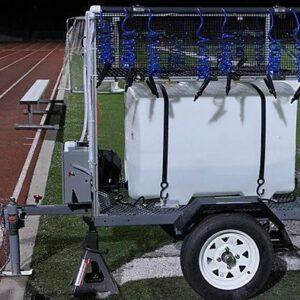 100 Gallon Rechargeable Football Hydration Station | Made In USA & New Low Price!$5,690.00
Product on sale 10″ Portable Pitching Mound | 2 Game Sizes | Made In USA QualityPrice range: $4,290.00 through $4,390.00