BACK.BACK.. By the time a player gets to high school, this admonition has been seared into his brain by all his previous coaches.
Confident and aggressive baserunning involves players developing their own instincts and making quick, independent decisions rather than solely relying on coaches. This approach emphasizes pushing the envelope and taking advantage of opponents' mistakes, a philosophy exemplified by the "CHAOS" motto used in youth league coaching. Players must learn to assess game situations, such as outfield dynamics, to maximize their chances of safely advancing or remaining on base. The traditional advice to "go half way" on a fly ball has zero validity, as optimal action depends entirely on the specific play.
The biggest weakness I encounter in otherwise quality players is their abysmal base running skills. They have never learned to get a quality lead…BACK.BACK.They have never learned to aggressively round the bag after a hit…BACK.BACK.They develop no instincts…BACK.BACK.
A player really must learn to be his own coach. The first base coach’s job is for the most part to pat the runner on the butt, say “nice hit,” take his batting gloves and remind him how many outs there are! The play is in front of him when he rounds the bag. He must decide if he can go to second. If he waits on the coach to wave or say go he probably isn’t going to make it. He shouldn’t need the coach to tell him how big a lead to get. He damm sure shouldn’t be listening for the coach to warn him a pick off move is coming!
The old adage to “go half way” on a fly ball has zero validity. If it is a fly to the foul pole in left he might be able to round second, and still beat the throw back to first and if it is a fly to short right half way may get him doubled off. In both scenarios, the decision to advance must be made quickly and with keen awareness of the game situation. Rounding the bases effectively requires a strong understanding of the outfield dynamics, which is where strategies like coachanswersrounding come into play. Players should always be prepared to assess the likelihood of a catch and act accordingly to maximize their chances of safely advancing or remaining on base.
The only times a runner must rely on a coach are on an over throw to first, whether to take third on a hit to right and whether to score from second.
When I coached youth league, I would ask the team before every game “what’s the word for the day?” and they would answer “CHAOS.” We were going to push the envelope at every chance, put pressure on the other team to make plays and aggressively take advantage of the other team’s mistakes.
We won a lot of games, scored a lot and the boys loved it. What is important is to never yell at them for making mistakes and being too aggressive. They know they pushed it too far. They didn’t make an out on purpose.
Remember, only if they make mistakes can they learn from them. You can tell them to never make the first or third out at third but until they dust themselves off and head back to the dugout, and you point out that there was no advantage to taking that risk and that they would have scored on the next batter’s hit, does it really strike home.
|
Bruce Lambin raised and coached two talented T-Ball players who became the best baseball players they could be. His oldest played at Texas while his youngest was the shortstop for Louisiana-Lafayette. Both later played with Team USA. Bruce has coached over 150 pro and college prospects (including six Major Leaguers) and continually shows a keen eye for many overlooked aspects of the game.Lambin is a CABA world champion baseball coach and he wrote a book, A Parent’s Guide to Baseball – Surviving and Thriving Youth League to College, that gives parents an inside look at baseball from youth league to college. |
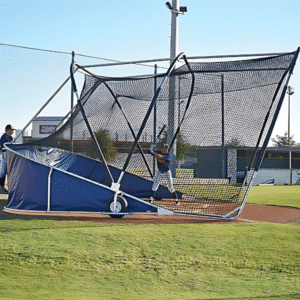 Big Bubba Elite Batting Cage Has All The Options$7,690.00
Product on sale 10″ Portable Pitching Mound | 2 Game Sizes | Made In USA QualityPrice range: $4,290.00 through $4,390.00
 The Heater Deuce 2 Wheel Pitching Machine | Our Lowest Cost 2 Wheel ModelsPrice range: $799.99 through $999.99