No one ever says “Gee, Margo, little Bubba is old enough, let’s get him on a baseball team, make complete jerks of ourselves and drive some coach crazy!”.but it happens. The wise coach understands that he is not just teaching boys to play baseball, but is shepherding a group of families through the baseball experience.
Coaches should handle parents by clearly communicating their roles and expectations, focusing on positive involvement while setting firm boundaries. Parents are encouraged to ensure timely attendance and support home training, but must avoid pressuring their children, coaching from the stands, or discussing lineup and playing time with the coach. This approach helps maintain a positive team environment and teaches players to address concerns directly with their coach, as demonstrated by Coach Gary Ward at Oklahoma State, who expected players to discuss problems in his office.
He must explain to the parents their role in this adventure. So here’s my list of do’s and don’ts that a coach should communicate to the parents.
- DO get your son to practice and games on time or arrange transportation. I am not a taxi service.
- When practice is over, take him home. I am not a baby sitter. (I once had a mother enroll in night school figuring that I’d watch her little darling every day after practice until she could pick him up!) The coach can’t leave any player at the field after practice, so that parent that shows up 15 minutes late is not to be tolerated.
- DO get involved. I need help.
- DO encourage your son to do his home training. This is just like homework and the parent needs to get involved and cherish the experience. This is important as it makes couch potato Dads get off their butts and share this precious time with their sons.
- DON’T pressure your son to succeed in the games. This experience is about the journey not the destination. It is probably not a good idea to go over his every mistake in last night’s game over breakfast.
- DO cheer for the team.
- DON’T cheer against the opposition. In fact, if they make a good play applaud.
- DON’T yell at the umpires. That is insulting to the coach and indicates that you think he won’t look out for the best interest of the team. Yelling, “Come on Blue” will not result in more favorable calls.
- DON’T coach from the stands. Is there anything worse than some Mom who knows nothing about baseball yelling little coaching catch phrases at her son while he tries to hit like, “get your elbow up?” I have no problem going over to the backstop and calling the Mom out and telling her to be quiet.
- DON’T come to me with your ideas about the lineup or playing time. This is probably the most important DON’T. It allows the coach to tell the parent/agent when he comes up to inform the coach that he thinks his son should be the shortstop, “What part of we are not going to have this conversation did you not understand?” Parents have no say so in how the team is run. Plus, the players are on the team, not the parents. If a player has something to say about his situation, he should talk with the coach.He must learn to confront his boss. That is one of those lessons in life we talk about learning from baseball. My eldest son played for Gary Ward at Oklahoma State. Coach Ward told them that if they weren’t man enough to come to his office and discuss a problem, then he didn’t think they had a problem. with baseball. My son says that for the rest of his life he will never be intimidated to meet with an executive, even the President of the US, because nothing could possibly be as scary as going to Coach Ward, but he did it and is a better man for it.
- DO your part in the field maintenance program, concession stand duty, etc. I even went so far as to tell the parents “I don’t do fields. I coach baseball. You will be responsible for organizing field duty.” It worked.
- HAVE FUN!!! Enjoy this precious time in your son’s life.
Parents can be your best friends or your worst nightmare. You control which.
|
Bruce Lambin raised and coached two talented T-Ball players who became the best baseball players they could be. His oldest played at Texas while his youngest was the shortstop for Louisiana-Lafayette. Both later played with Team USA. Bruce has coached over 150 pro and college prospects (including six Major Leaguers) and continually shows a keen eye for many overlooked aspects of the game.Lambin is a CABA world champion baseball coach and he wrote a book, A Parent’s Guide to Baseball – Surviving and Thriving Youth League to College, that gives parents an inside look at baseball from youth league to college. |
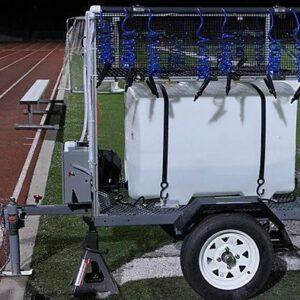 100 Gallon Rechargeable Football Hydration Station | Made In USA & New Low Price!$5,690.00
Product on sale 10″ Portable Pitching Mound | 2 Game Sizes | Made In USA QualityPrice range: $4,290.00 through $4,390.00