
TL;DR: Baseball screens protect pitchers, coaches, and players from dangerous line drives during batting practice and drills. The L-screen is the most common type, used by coaches to throw batting practice safely. Choosing the right frame material and netting weight for your level of use is the most important buying decision you will make.
What Is an L-Screen in Baseball?
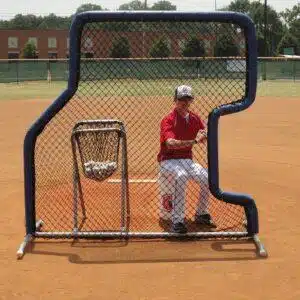
An L-screen in baseball is a protective net shaped like the letter L that stands in front of a pitcher or coach during batting practice, blocking line drives while leaving a throw-through cutout open for pitching. The cutout lets the thrower deliver pitches without moving the screen, while the frame and netting absorb the impact of any batted ball that comes straight back up the middle.
L-screens are the standard pitching screen at every level of baseball, from youth travel ball to college programs. You will find them on nearly every practice field because they solve the most common safety problem in batting practice: a coach or pitcher standing directly in the line of fire with no protection.
Browse the full selection at Baseball Tips L-Screens and Softball Screens.
What Is an L-Screen Used For?
An L-screen is used to protect the pitcher or coach who throws batting practice from being hit by a line drive coming back through the middle. The thrower stands behind the tall vertical panel, which stops direct comebackers, while the horizontal foot of the L keeps the screen stable on the ground without tipping forward.
Common uses include:
- Live batting practice on the field or in a cage
- High school and college daily practice sessions
- Fungo hitting stations where a coach hits grounders or fly balls
- Any drill where a coach or player stands in a direct hit zone
The L-screen is best for live batting practice, high school and college programs, and daily use environments. Look for welded steel or heavy aluminum frames, reinforced cutout edges, and UV-treated #60 or #96 netting for outdoor use.
See the Pro Baseball Trifold Screen 8 x 15 as one example of a heavy-use option built for varsity-level work.
How to Protect Pitchers During Batting Practice
The most reliable way to protect pitchers during batting practice is to place a properly sized L-screen directly in front of the pitching position so every throw goes through the cutout and the netting blocks any ball hit back up the middle. This removes the risk of a comebacker reaching the pitcher before they can react.
Follow these steps to get the most protection from your screen setup:
- Use the right size. A 7 ft x 7 ft screen covers most pitchers. An 8 ft x 8 ft screen suits taller throwers or coaches who need more coverage.
- Choose the right netting weight. Use #60 netting for moderate use. Use #96 or double-thick netting for heavy varsity or daily college-level use.
- Position the screen correctly. The vertical panel should face the batter. The thrower stands close behind the panel and delivers the pitch through the cutout.
- Inspect the screen before every practice. Frayed netting or bent frames reduce protection. Replace damaged screens immediately.
- Choose a welded frame for daily use. Bolted frames can loosen over time. Welded steel or heavy aluminum frames last longer under repeated impact.
If your current screen is bent, undersized, or has frayed netting, it is no longer doing its job. Check the Oversized Pro Baseball Screens with Wheel Kit for a durable daily-use upgrade, or the Trifold Screen with Wheels Included for a portable option that still handles heavy workloads.
What Types of Baseball Screens Are There?
Baseball screens come in seven main types, and each one serves a different drill, space, or use frequency. Choosing the wrong type for your program means either overpaying for features you do not need or buying an underbuilt screen that wears out quickly.
| Screen Type | Best Use | Typical User | Key Feature |
|---|---|---|---|
| L-Screen | Live batting practice | High school, college, travel teams | Throw-through cutout |
| I-Screen | Bullpens, tight spaces | Programs with limited space | Tall and narrow profile |
| C-Screen | Catcher drills, short-toss | Catchers, utility drill stations | Wider lateral coverage |
| Full-Frame Field Screen | Infield drills, multi-player reps | Varsity, college programs | Broad coverage, 8×10 to 10×12 sizes |
| Portable / Pop-Up Screen | Travel, youth practice | Youth leagues, travel teams | Fast setup, folds flat |
| Hitting Sock / Short-Toss Screen | Soft toss, cage work | All levels for indoor drills | Compact, low-impact use |
| Flip-Over Combo Screen | Multi-drill stations | Programs running varied drills | Converts between screen styles |
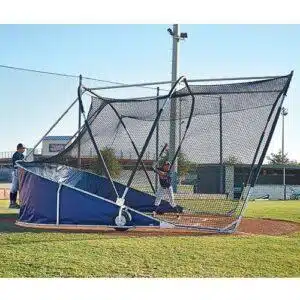
I-screens are tall and narrow, making them a good fit for bullpens and tight spaces. C-screens provide wider lateral coverage for catcher drills and short-toss work. Full-frame field screens are common in sizes like 8 ft x 10 ft, 10 ft x 10 ft, and 10 ft x 12 ft. Portable and pop-up screens set up quickly and fold flat for transport, but they are best suited for light to moderate use.
For a deeper look at all screen categories, read The Ultimate Guide to Baseball Screens: Selection, Quality and Maintenance.
Which Screen Specs Actually Matter?
Three specs determine whether a baseball screen will hold up for your program: size, frame material, and netting grade. Getting any one of these wrong means buying a replacement sooner than you should.
Size
A 7 ft x 7 ft screen covers most pitchers. An 8 ft x 8 ft screen suits taller throwers or coaches who need a larger coverage area.
Frame Material
- Aluminum: Lighter and easier to move, good for programs that travel or rotate screens between stations.
- Galvanized steel: Heavier and more durable, better for permanent or semi-permanent outdoor setups.
- Welded frames: Last the longest under repeated impact. Bolted frames can work loose over a season of daily use.
Netting Grade
- #60 netting: Suitable for moderate use at the youth or recreational level.
- #96 or double-thick netting: Required for heavy varsity or college-level daily use.
- UV-treated netting: Needed for any screen used outdoors to prevent breakdown from sun exposure.
Programs practicing daily should prioritize welded frames and heavier netting to withstand repeated impact. If you are unsure which grade fits your schedule, call 800-487-7432 or email baseballtips@gmail.com for expert guidance.
Quick Recap
- Baseball screens are essential safety equipment, not optional gear.
- The L-screen is the most widely used screen in baseball because its throw-through cutout lets coaches pitch while staying protected.
- L-screens protect pitchers during batting practice by blocking comebackers before they can reach the thrower.
- I-screens fit bullpens and tight spaces. C-screens cover catcher and short-toss drills. Full-frame screens protect infield stations.
- Choose #96 or double-thick UV-treated netting and a welded frame for daily use at the high school level or above.
- A 7 ft x 7 ft screen fits most pitchers. Go to 8 ft x 8 ft for taller throwers.
- Inspect screens before every practice. Frayed netting and bent frames must be replaced immediately.
- Screens are organized into Good (entry-level), Team / Better (school-grade), and Oversized Pro Models for daily high-impact use.
Frequently Asked Questions
What is the difference between an L-screen and an I-screen?
An L-screen has a horizontal base that gives it an L shape and includes a throw-through cutout for batting practice. An I-screen is tall and narrow without that base, making it better for bullpens or tight spaces where a coach does not need to throw through the screen.
What size L-screen do I need?
A 7 ft x 7 ft L-screen covers most pitchers and coaches. If your throwers are taller or you want extra coverage, move up to an 8 ft x 8 ft model.
How do I know if my baseball screen needs to be replaced?
Replace your screen if the netting is frayed or has holes, if the frame is bent, or if the screen no longer stands stable. A damaged screen does not provide full protection and should not be used.
Can I use a portable pop-up screen for varsity practice?
Portable pop-up screens are built for light to moderate use and are best suited for youth leagues and travel teams. For varsity or college daily practice, use a welded steel frame screen with #96 or double-thick netting.
What netting weight should I use for outdoor batting practice?
Use UV-treated netting for any screen used outdoors. Choose #60 for moderate use and #96 or double-thick netting for daily high-impact use at the high school level or above.
Is a C-screen the same as an L-screen?
No. A C-screen provides wider lateral coverage and is designed for catcher drills and short-toss work. An L-screen is designed specifically for batting practice with a throw-through cutout for the pitcher or coach.
Where can I get help choosing the right baseball screen for my program?
Call 800-487-7432 or email baseballtips@gmail.com for direct guidance. You can also browse all options at the baseball and softball screens page or read The Ultimate Guide to Baseball Screens.
Get the Right Screen for Your Program
Every practice carries risk. The right baseball screen reduces that risk immediately. Whether you run a youth travel team or a daily college program, there is a screen built for your workload and your budget.
- Oversized Pro Baseball Screens with Wheel Kit for daily high-impact use
- Pro Baseball Trifold Screen 8 x 15 for varsity and college-level coverage
- Trifold Screen with Wheels Included for programs that need mobility without sacrificing durability
Call 800-487-7432 or email baseballtips@gmail.com to get expert guidance and choose the right screen the first time. You can also add screens directly: Add screen 12767 to cart | Add screen 13191 to cart.