
⚾ What Equipment Does a High School Baseball Program Actually Need? (Complete Buyer’s Checklist)
TL;DR
A competitive high school baseball program needs three equipment tiers: essential field maintenance and safety gear ($5K-8K), practice quality equipment like pitching machines and batting cages ($8K-15K), and facility upgrades for recruiting ($15K+). Focus first on what protects players and enables daily practice, then invest in equipment that creates more quality repetitions.
I’ve been asked this question more times than I can count, usually by a first-year head coach or an athletic director who just inherited a program with a garage full of broken screens and a pitching machine that hasn’t worked since 2008.
What do you actually need to run a high school baseball program?
Not what the catalog says. Not what the college down the road has. What do YOU need to field a competitive team, keep kids safe, and not blow through your budget by February?
Here’s what I’ve seen work across 25+ years of coaching and working with programs from small rural schools to competitive suburban programs. My recommendations for a high school baseball equipment checklist:
🧢 What’s Actually Essential vs. What’s Nice to Have
Let me be direct about something that confuses a lot of new coaches and ADs: there’s a massive difference between equipment you MUST have and equipment that makes life easier.
I’ve seen programs with $50,000 worth of gear that can’t practice efficiently because they’re missing a $400 L-screen. I’ve also seen programs with bare-bones setups that develop players better than schools with twice the budget.
The secret? They invested in equipment that creates more quality repetitions, not equipment that looks impressive.
Your job is to figure out where your program falls on that spectrum, then spend accordingly. And yeah, I know budget realities mean you can’t buy everything at once. That’s why I’m breaking this down into tiers.
🥎 Tier 1: The Non-Negotiables (Budget: $5,000-$8,000)
These are the items you absolutely cannot run a program without. If your budget forces you to choose, this is where every dollar goes first.
⚾ What Makes This List Essential?
Simple. Without these items, you either can’t practice safely, can’t maintain your field to a playable standard, or you’re wasting massive amounts of practice time.
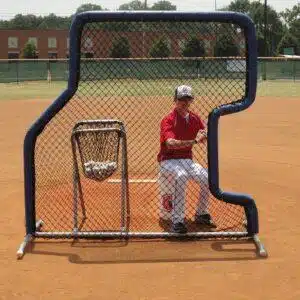
🛡️ L-Screen or Pitching Screen ($400-$800)
I don’t care if you’ve been throwing BP without protection for 20 years. One line drive to the knee ends that streak real quick. Get a quality 7×7 L-screen with a wheel kit so you can move it in and out of the cage without wrestling the thing.
The wheel kit matters more than you think. A screen that’s a pain to move gets left in the corner, and then nobody uses it.
🧹 Basic Field Maintenance Equipment ($800-$1,500)
You need at minimum:
-
One quality field drag (6′ flexible drag mat will cover most programs)
-
Field rake or two
-
Dry line marker for chalking
-
Tamp for around the bases and plate
Without this stuff, your field becomes unplayable by mid-season. I’ve watched programs spend $3,000 on new uniforms while their infield has lips so bad that routine ground balls become adventure plays. Fix the field first.
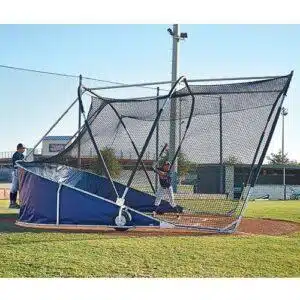
🏟️ Batting Cage or Batting Turtle ($3,000-$6,000)
This is your single biggest investment in Tier 1, and it’s where programs often go wrong. They either buy junk that falls apart in two seasons, or they stretch the budget so thin trying to get a batting cage that they can’t afford anything else.
Here’s my take: a shorter cage with heavier netting beats a longer cage with lighter netting every single time. You want something that’ll last 10+ years, not something that needs net replacement in year three.
If space is tight or you need something mobile, a quality batting turtle like the Big Bubba runs $6,500-$7,500 but will outlast cheaper alternatives by a decade. For permanent setups, a basic 55′ cage starts around $5,000.
The cage is your workhorse. Players who can walk out to the field and get swings without waiting for a pitcher or dad to show up will hit more in one season than players without cage access hit in three seasons.
⚾ Baseball Cart or Ball Caddy ($350-$450)
Sounds minor until you’ve watched three kids chasing baseballs around the outfield while 12 others stand around during a drill. A quality ball cart that holds 300 baseballs keeps practice moving.
🧤 Protective Screens for Infield Work ($300-$600)
At minimum, get one portable screen for fungo work. The short toss screens (7×7) give your coaches protection during ground ball drills and infield practice.
⚾ Tier 1 Budget Reality Check
Bare minimum program: $5,000-$6,000
Solid foundation: $7,000-$8,000
If you’re starting from zero and have less than $5,000, focus on the L-screen, field maintenance basics, and save the rest toward a cage. Don’t buy cheap alternatives just to check boxes.
⚾ Tier 2: Equipment That Elevates Practice Quality (Budget: $8,000-$15,000)
Once you’ve covered the essentials, this is where you invest to create better practices and more development opportunities.
⚾ What Separates Tier 2 from Tier 1?
Tier 1 lets you practice. Tier 2 lets you practice BETTER. This equipment creates more quality repetitions, allows for more position-specific work, and generally separates programs that compete from programs that just show up.
⚾ Pitching Machine ($800-$2,500)
Real talk: pitching machines are where coaches overthink things. You don’t need a $5,000 machine that throws 12 different pitches. You need something reliable that throws strikes for 3-4 hours without overheating.
For most high school programs, a quality 2-wheel machine in the $1,500-$2,000 range does everything you need. It’ll throw fastballs, simulate breaking balls, and handle the abuse of daily use.
If budget is really tight, you can find solid single-wheel machines around $800-$1,000. They won’t throw every pitch, but they throw strikes, and strikes are what your hitters need to see.
The real value? Now players can take 50 quality swings in 20 minutes instead of 15 swings in 30 minutes waiting for live BP. That’s the math that matters.
https://baseballtips.com/baseball-field-equipment/team-pitching-machines
⛰️ Portable Pitching Mound ($1,400-$2,200)
If you practice on a field without a permanent mound, or if you do any indoor work, a quality portable mound changes everything for your pitchers.
The 6″ tall models run $1,400-$1,500 and work great for most programs. If you’re doing a lot of bullpen work or want game-height, the 10″ models run $2,000-$2,200.
Don’t cheap out here. A mound that breaks down or doesn’t hold its shape creates bad habits and potential arm injuries.
https://baseballtips.com/baseball-field-equipment/portable-pitching-mounds
🌧️ Weighted Field Covers ($800-$2,500)
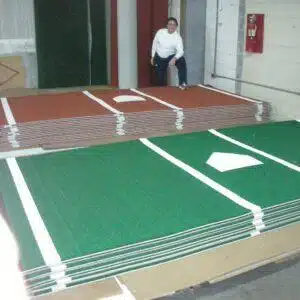
Mound covers, plate covers, and small bullpen covers are the difference between playing after a rain and canceling for three days while your field dries.
The weighted vinyl covers run $100-$300 each depending on size. Start with a mound cover and plate cover at minimum.
For programs in rainy climates or with drainage issues, a full infield tarp is a significant investment ($3,000-$9,000) but pays for itself the first time it saves a weekend series.
https://baseballtips.com/field-maintenance-equipment/baseball-tarps-infield-covers-weighted-tarps
🛡️ Additional Screens and Backstops ($500-$1,500)
Once you have your basic L-screen, adding a tri-fold screen for outfield work, a second L-screen for simultaneous stations, or a taller fungo screen expands what you can do in practice.
https://baseballtips.com/baseball-screens-softball-screens-l-screens
🧢 Batting Cage Accessories ($400-$800)
If you have a cage, adding quality hitting mats ($300-$350), a second ball cart, and replacement nets when needed keeps the cage functional.
⚾ Tier 2 Budget Reality Check
Minimum additions: $3,000-$5,000 (pitching machine, basic covers)
Complete Tier 2 program: $8,000-$12,000
Well-equipped program: $12,000-$15,000
⚾ Tier 3: Facility Upgrades That Matter for Recruiting (Budget: $15,000+)
This is where you separate a functional program from a program that attracts talent and makes players want to be there.
⚾ What Goes in Tier 3?
Everything in this tier is about perception and player experience. Does it make you a better team? Not directly. Does it help recruiting? Absolutely.
🪑 Quality Team Benches ($1,000-$3,000)
Aluminum dugout benches with backs, or even better, benches with top shelves for gear organization. Players and parents notice when your dugout looks professional.
https://baseballtips.com/team-aluminum-benches
🧢 Dugout Organization Systems ($300-$800)
Bat racks, helmet trees, permanent mount storage. These are small investments that make a big impression.
https://baseballtips.com/baseball-field-equipment/bat-racks-helmet-racks-for-dugouts
💡 Field Lighting (if applicable) ($20,000-$100,000+)
Obviously not feasible for many programs, but if you’re planning long-term capital improvements, lights transform a program’s ability to practice and play.
🏟️ Upgraded Backstops and Fencing ($5,000-$20,000)
This is often a multi-year project or a bond issue item, but quality backstops and proper fencing make a field look and feel legitimate.
https://baseballtips.com/baseball-screens-softball-screens-l-screens/permanent-field-backstops
📟 Scoreboard ($3,000-$15,000)
Again, not essential, but a working scoreboard adds a professional touch that matters for home games and recruiting visits.
⚾ What Equipment Lasts and What Doesn’t
Here’s what you need to know about replacement timelines:
10+ Year Equipment (if you buy quality):
-
Batting cages and batting turtles
-
Aluminum dugout benches
-
L-screens and protective screens
-
Field drags and groomers
-
Portable pitching mounds
5-7 Year Equipment:
-
Pitching machines (with proper maintenance)
-
Batting cage nets (depending on use)
-
Field covers and tarps
1-3 Year Equipment:
-
Baseballs and softballs
-
Hitting mats
-
Small field accessories
The lesson? Spend more upfront on items you’ll use for a decade. Cheap batting cages that need replacement in five years cost more than quality cages that last 15.
⚾ Budget Allocation by Program Size
Small Program (1 varsity team, $5K annual budget):
-
Focus 100% on Tier 1 essentials
-
Save toward batting cage over 2-3 years
-
Used equipment is fine for screens and carts
Medium Program (V/JV teams, $15K annual budget):
-
Cover all Tier 1 in year one
-
Add Tier 2 pitching machine and mound in year two
-
Build toward complete Tier 2 by year three
Large Program (V/JV/Freshman teams, $30K+ annual budget):
-
Complete Tier 1 and most of Tier 2 in year one
-
Address Tier 3 facility improvements years 2-3
-
Focus on replacement and upgrades after initial build-out
⚾ What I’d Buy First If Starting From Zero
If I walked into a program tomorrow with $10,000 and zero equipment, here’s my shopping list:
-
L-screen with wheels
-
6′ flexible field drag, rake, tamp, line marker
-
Quality batting cage or batting turtle
-
Baseball cart
-
2-wheel pitching machine
-
Portable screen for fungo
That gives you everything you need to run quality practices, protect your coaches, maintain your field, and develop hitters. Everything else can wait.
⚾ The Bottom Line
Here’s what 25+ years has taught me: programs succeed when they invest in equipment that creates more quality repetitions and protects players and coaches. Everything else is secondary.
Don’t buy to impress. Don’t buy because the school across town has it. Buy what enables your kids to practice more effectively, then use that practice time to develop ballplayers.
The fancy stuff in Tier 3? That’s great when you can afford it, but I’ve seen programs with borrowed equipment and a portable cage develop more college players than programs with scoreboards and perfect dugouts.
Focus on what matters. Your equipment budget should reflect your priorities: player safety, quality practice time, and field playability. Get those three right, and the wins will follow.
Need help figuring out what fits your specific program and budget? Give us a call at 1-800-487-7432. I’ve done this enough times to help you avoid the expensive mistakes most programs make.
Explore our complete baseball equipment lineup here- https://baseballtips.com/