I have a 9 year old who has been playing ball for 4 years and has been hitting balls pretty good. In the last two months, he has moved to travel ball and has not been hitting very well. Out of a bucket of balls thrown from 30’ he could not hit but one. He has been going to batting cages and is batting at 45 to 55 mph. ok.
His swing is complete and straight with no head-turning and he is not stepping out of the box.
I don’t know what to tell him anymore I know he can see the ball and follow it to the plate.
What do you think is the problem? Using a 29 x 19oz bat.
A 9-year-old's batting slump, particularly after transitioning to travel ball, is often rooted in issues with timing and balance. The increased competition can expose these fundamental mechanical weaknesses, even in players who have been hitting well for four years. To improve, the page suggests focusing on foundational drills like hitting off a stationary batting tee and practicing front toss drills. These methods help rebuild confidence and refine a player's timing and balance at the plate.
Thanks
Richard
____________________________________________________________________________________________________________________________________________________________________________
Richard
You can take this to the bank; Hitting is all about timing and balance. Though I do not have the advantage of putting my eyes on him, I would suggest some of this solid advise.
Choose some or all of the following tips as you feel fits:
Begin with hitting off a stationary batting tee. Tee work is important and a staple (though I hate to use the word “work” with younger players) Ideally, you would have a catch net or a screen you could hit into. Those two pieces make for a batting tee station that you will use throughout your player’s “career”. Use any ball but nice to start with light balls, meaning wiffles, safety balls or equivalent. Make it easy and as always have a goal or objective such as trying to hit to the shortstop or 2nd baseman. Count how many “successes’ in a row. And make sure you stop swinging when the bat path is changing. We forget that the bat can get heavy after some swings… Take a 2 minute water or ball shagging break and he will be like brand new after a short break.
Throw him balls (plastic or soft) underhand from out in front while sitting on a bucket or chair from perhaps 15 feet 9adjust as you are comfortable though too close may make it harder due to the reaction time). Underhand is important and from in front at close range is important and known as front toss drills. These will help him to time the pitch easily and may expose flaws that you can visibly see better. If you are behind a screen, this will allow you to keep your eyes on the hitter as he swings. As he gains confidence with front toss drills, gradually incorporate variations in pitch speed and angle to enhance his adaptability at the plate. Focusing on balancing hitting mechanics and power will help him develop a more consistent swing while also generating the necessary force to drive the ball. Regular practice will not only refine his technique but also build muscle memory, making him a more effective hitter in game situations.
2. Throw to him live after the front toss drill so he can hit it at a closer-to-game distance. Don’t worry about speed and ski[p this if he is struggling at front toss.
3. Some where along the line do a drill of taking the bat away and having him just stand there and watch the ball so he can tell if it is a ball or strike and get use to the ball coming at him and judging it. This exercise will help him develop better pitch recognition and improve his ability to make quick decisions at the plate. Additionally, integrating catcher’s throw techniques and tips during practice can enhance his understanding of defensive mechanics and the overall game dynamics. By regularly simulating these scenarios, he will build confidence and better prepare himself for game situations. Moreover, focusing on spacesaving batting techniques can allow him to develop a more compact swing, leading to increased bat speed and better contact with the ball. Encouraging him to practice these techniques in tandem with the pitch recognition drills will create a more versatile offensive player. Ultimately, combining these skills will significantly enhance his performance at the plate and contribute to his overall growth as a player.
5. Limit the pitching machine for a couple of weeks while doing the drill above then reintroduce the machine.
6. Then in about 3 weeks you hitting routine should be TEE WORK- FRONT TOSS- WATCH 10 PITCHES-15 LIVE PITCHES- THEN THE MACHINE THE REST OF THE TIME.
When you do this he will start to hit the ball when it is pitched live/machine but you have to work on hand-eye coordination first and foremost.

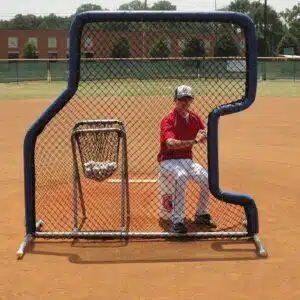
 L Screen | 7′ x 7′ Team Model | Optional Wheels & PaddingPrice range: $390.00 through $640.00