
TL;DR: Shortstop is the most demanding position in baseball. A shortstop stands 12 to 15 feet behind the baseline, halfway between second and third base. To play the position well, you need quick feet, a strong arm, soft hands, and the baseball IQ to lead the entire infield.
Shortstop is the most demanding position on the field, requiring elite footwork, range, arm strength, and baseball IQ. This guide covers proper positioning in every game situation, proven drills to improve first-step quickness and hands, common mistakes shortstops make and how to fix them, mental preparation, and age-appropriate training schedules. You will also learn which equipment actually matters for shortstop development and how to train like next-level players.
What Is Shortstop in Baseball?
Shortstop in baseball is the infield position played between second base and third base, and it is widely considered the most demanding defensive position on the field. The shortstop handles more ground balls than any other infielder, leads communication in the infield, turns double plays, and must cover a wide range of ground on both sides. A shortstop faces 150 or more chances in a typical season, and one missed play can change the outcome of a game.
Playing shortstop at a high level requires range, a strong and accurate arm, soft hands, quick feet, and the mental toughness to stay composed after an error. If you want to play the position at the next level, natural talent alone will not get you there. You need the right technique and consistent training.
Start building that foundation with these shortstop training drills that have helped players at every level improve fast.
What Is the Shortstop Position?
The shortstop position is the infield spot assigned to the player who covers the area between second and third base, and it is the central hub of the entire defense. In the official scoring system, shortstop is numbered position 6. The shortstop is responsible for fielding ground balls in the hole, covering second base on steals and double plays, directing infield positioning, and serving as a relay and cutoff man on throws from the outfield.
No other position demands the same combination of physical tools and mental skills. The shortstop must process the game situation before every pitch and adjust positioning, communication, and reactions in real time.
| Attribute | Shortstop (6) | Second Base (4) | Third Base (5) |
|---|---|---|---|
| Arm strength needed | Very strong | Moderate | Strong |
| Range required | Widest of all infield spots | Wide, shorter throws | Limited, reaction-based |
| Double play role | Feeds and turns | Feeds and turns | Initiates 5-4-3 |
| Infield leadership | Primary leader | Secondary | Corner role |
| Scoring number | 6 | 4 | 5 |
Where Does a Shortstop Stand?
A shortstop stands 12 to 15 feet behind the baseline, roughly halfway between second base and third base. That is the standard starting depth for most game situations, but the exact spot shifts based on the hitter, the count, the pitcher, and runners on base.
Key positioning rules:
- Move 15 to 18 feet back for power hitters
- Shallow up to 8 to 10 feet back for contact hitters or late-game situations
- Shade toward the hole against pull hitters
- Cheat toward the middle against opposite-field hitters
- Play deeper when your pitcher throws slower velocity
Pre-pitch stance:
- Feet slightly wider than shoulder-width apart
- Weight on the balls of your feet
- Hands resting on knees
- Eyes on the pitcher’s release point
Ready position as the pitcher delivers:
- Hands rise to waist level
- Slight forward lean
- Mini-hop or shuffle step as the ball crosses the plate
- Weight shifts forward so you can explode in any direction
What Makes a Good Shortstop?
A good shortstop combines physical tools like a quick first step, a strong and accurate arm, soft hands, and range to both sides with mental skills like anticipation, communication, composure, and high baseball IQ. Elite shortstops read the swing before the ball is hit, throw from multiple arm angles, lead the infield out loud, and shake off errors without hesitation.
Physical tools every shortstop needs:
- Quick first step
- Strong, accurate arm
- Soft hands
- Range to both sides
- Speed (a 6.8 sixty-yard dash or faster is the benchmark for college-level play)
Mental skills that separate good from elite:
- Anticipation, reading swings before contact
- Communication, directing the entire infield
- Composure, recovering from errors immediately
- Baseball IQ, knowing situations before they happen
What separates elite shortstops from average ones:
- Exceptional first-step quickness
- Ability to throw from multiple arm angles
- Anticipation before the ball is hit
- Range to both sides, especially up the middle
- Consistent double-play feeds and turns
- Leadership that holds the infield together
If your shortstop cannot do these things, you are playing defense with a liability instead of an asset.
What Are the Shortstop’s Responsibilities?
The shortstop is responsible for fielding ground balls between second and third base, covering second base on steals and double plays, turning 6-4-3 and 6-3 double plays, serving as a relay man on outfield throws, and leading infield communication on every pitch.
Primary defensive duties:
- Field anything hit between second and third base
- Cover balls in the hole between short and third
- Handle slow rollers up the middle
- Cover second base on steal attempts when the second baseman takes the ball
- Cover second on balls hit to the right side of the infield
- Serve as cutoff man on throws from right field
- Receive feeds from second base, third base, and the pitcher to turn double plays
- Make the pivot at second base on feeds from the first or second baseman
- Execute 6-4-3, 6-3, and 6-3-1 double plays
Communication duties:
- Direct infield positioning before every pitch
- Call who covers second base on steal attempts
- Alert teammates to bunt situations
- Organize cutoff alignments on balls hit to the outfield
Shortstop Positioning for Every Situation
Shortstop positioning changes with every runner and every count. Your base position is 12 to 15 feet behind the baseline between second and third, but you must adjust based on who is on base and what the defense needs.
Runner on first, double-play depth:
- Move 2 to 3 steps closer to second base
- Stay at normal depth or slightly shallow
- Be ready to cover second on steal attempts
Runner on second:
- Play at normal depth unless a bunt is possible
- Communicate with the second baseman on who covers on a steal
Runners on first and third:
- Middle infield depth for double play opportunity
- Stay alert for pickoff plays at third
Late innings, tie game, runner on third:
- Play in at 6 to 8 feet back to cut off the run at the plate
- Charge any ball you can handle to get the force at home
Shift positioning: Modern baseball uses defensive shifts regularly. Your coach may shift you toward first base against dead-pull left-handed hitters, placing you nearly at second base and creating a four-man infield on one side. Against extreme pull right-handed hitters, you may play closer to normal depth while the third baseman moves into the shortstop zone. Trust your coach’s positioning, but stay alert. Shifts work on averages, and any individual hitter can beat them.
Best Shortstop Drills to Build Range and Arm Strength
The best shortstop drills target first-step quickness, clean hands, double-play footwork, backhand technique, and reaction time. These five drills address every area a shortstop must develop to compete at the next level.
Drill 1: Crossover Step Drill (Footwork and First-Step Quickness)
This drill trains the explosive crossover step that gets you to balls on both sides.
- Start in your ready position
- On a signal, take a crossover step to your left or right
- Drive off the opposite foot and close ground as fast as possible
- Work both directions equally
- Progress to reacting to a coach’s hand signal or a live ground ball
Drill 2: Bare-Hand Ground Balls
Removing the glove forces you to develop soft, confident hands.
- Have a partner roll or toss slow ground balls
- Field each ball with your bare throwing hand
- Focus on getting your body in front and letting the ball come to you
- Keep your hand relaxed, not stiff
- Progress to slightly faster rollers as your hands improve
Drill 3: Double-Play Feeds to Second Base
Consistent, accurate feeds are what turn routine double plays instead of costing you outs.
- Start at shortstop depth with a partner at second base
- Field ground balls and make underhand or sidearm feeds to second
- Work on both the backhand flip and the overhand toss from deeper in the hole
- Your partner simulates the pivot and throw to first
- Repeat until the feed is automatic under pressure
Drill 4: Backhand Technique
The backhand play into the hole is one of the hardest plays in baseball and one of the most important for a shortstop to master.
- Set up at normal depth
- Have a partner hit or roll balls deep into the hole toward third base
- Drive to the ball on a backhand angle, planting your right foot to field it
- Gather your footwork and make a strong throw across the diamond
- Focus on balance through the fielding motion before the throw
Drill 5: Reaction Ball Drill
A reaction ball has an irregular shape that bounces unpredictably, training your hands to adjust to bad hops in real time.
- Toss a reaction ball against a flat wall or hard surface
- Field each unpredictable bounce as cleanly as possible
- Start close and increase distance as your reaction time improves
- This drill also works well using an L-screen setup during team practice for added safety
For more drills designed specifically for this position, visit the full shortstop training drills page.
Common Shortstop Mistakes and How to Fix Them
The most common shortstop mistakes are fielding with a stiff body, not getting in front of ground balls, rushing throws, and losing focus between pitches. Fixing these habits early prevents them from showing up in game situations.
- Fielding with stiff hands: Relax your hands and let the ball travel into your glove. Bare-hand drills fix this fast.
- Not getting your body in front: Lazy footwork leads to errors. Work crossover steps daily so positioning your body becomes automatic.
- Rushing throws: Most throwing errors come from rushing. Gather your feet before every throw, even when you feel pressure.
- Flat feet at pitch release: If your weight is back when the ball is hit, you lose a full step. The mini-hop or shuffle step at pitch release fixes this.
- Poor communication: Not calling coverages out loud creates confusion. Make it a habit to communicate before every pitch, not just when you think something will happen.
- Losing focus between pitches: Elite shortstops reset mentally after every pitch and review the situation. Build that routine now.
How Should a Shortstop Prepare Mentally?
A shortstop should prepare mentally by reviewing the game situation before every pitch, communicating coverages with teammates out loud, and having a reset routine to shake off errors quickly. Mental preparation is what allows physical skills to show up consistently under pressure.
During each at-bat:
- Study the hitter’s stance and swing tendencies
- Know the count and adjust your depth accordingly
- Anticipate where the ball is likely to be hit based on the pitch type
- Know your throw before the ball arrives
Between innings:
- Review who is coming up and how they hit
- Confirm coverages with the second baseman and third baseman
- Reset mentally from the previous inning, good or bad
Training Schedule for Shortstops
A shortstop’s training schedule should include daily footwork work, regular throwing sessions, and fielding repetitions at least three to four days per week. Adjust the volume based on age and physical maturity.
- Monday: Footwork drills, crossover steps, lateral shuffles
- Tuesday: Ground ball repetitions, backhand work, double-play feeds
- Wednesday: Throwing program, arm care, long toss
- Thursday: Reaction ball drill, bare-hand work, situational fielding
- Friday: Full defensive practice or team workout
- Saturday: Game or live reps
- Sunday: Rest or light movement, arm care only
Younger players should reduce volume and prioritize technique over repetition count. Train the movements correctly first, then add speed and intensity.
Equipment for Shortstop Training
The right equipment helps you get more quality reps in less time, whether you are training alone or running a team practice.
For team training:
- A high-capacity ball cart saves time during large-group fielding sessions. The Pro Baseball Cart holds up to 300 baseballs or 150 softballs and now includes wheel protectors.
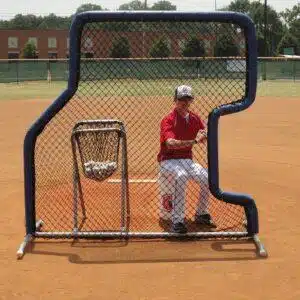
- A quality L-screen protects coaches feeding ground balls and fungos during shortstop drills.
- Proper baseball bases set up at correct distances are essential for double-play and situational drills.
For individual training:
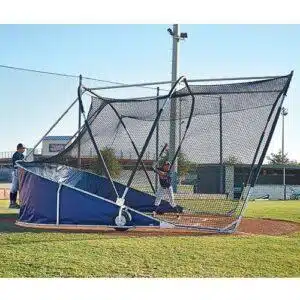
- A batting cage gives you a controlled space to work on throwing mechanics and reaction drills year-round.
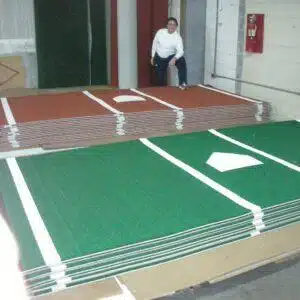
- Turf mats protect your knees and joints during repetitive fielding work on hard surfaces, and they simulate infield conditions when grass is not available.
Quick Recap
- Shortstop stands 12 to 15 feet behind the baseline between second and third base.
- It is the most demanding position in baseball, requiring range, arm strength, soft hands, and baseball IQ.
- Positioning shifts based on the hitter, count, runners on base, and game situation.
- A good shortstop leads the infield with communication before every pitch.
- The five key drills are the crossover step, bare-hand ground balls, double-play feeds, backhand technique, and reaction ball work.
- The most common mistakes are stiff hands, poor footwork, rushing throws, and losing focus between pitches.
- Mental prep, including knowing the situation before the pitch, is just as important as physical tools.
- The right training equipment, from ball carts to L-screens to turf mats, helps you get more quality reps.
- Train technique first, then add speed and volume as you improve.
Frequently Asked Questions
What does SS stand for in baseball?
SS stands for shortstop. In the official scoring system, shortstop is also assigned the number 6.
Is shortstop the hardest position in baseball?
Shortstop is widely considered the most demanding defensive position in baseball. It requires the widest range of any infielder, a strong and accurate arm, soft hands, and the mental ability to lead the entire infield on every pitch.
Where is shortstop on the field?
Shortstop is on the left side of the infield, positioned between second base and third base. The standard starting depth is 12 to 15 feet behind the baseline.
What skills does a shortstop need?
A shortstop needs a quick first step, a strong and accurate arm, soft hands, range to both sides, speed, and mental skills like anticipation, communication, and composure. A 6.8 sixty-yard dash or faster is a common benchmark for college-level shortstops.
What is the shortstop’s role in a double play?
In a double play, the shortstop either feeds the ball to second base or receives a feed at second base and makes the relay throw to first base. Common double plays involving the shortstop include the 6-4-3, 6-3, and 6-3-1.
How should a shortstop position differently with a runner on first?
With a runner on first, the shortstop moves 2 to 3 steps closer to second base to improve double-play positioning. The shortstop stays at normal depth or slightly shallower and stays ready to cover second on a steal attempt.
What drills help shortstops the most?
The most effective shortstop drills are the crossover step drill for first-step quickness, bare-hand ground ball work for soft hands, double-play feed repetitions, backhand technique drills into the hole, and reaction ball drills for handling bad hops.