
TL;DR: Baseball players train differently than other athletes because the sport demands explosive rotational power, shoulder stability, and anaerobic energy systems rather than bulk or endurance. Training focuses on bat speed, ball velocity, core rotation, and visual and mental skills that other sports rarely require.
What About Baseball Makes It Unique as a Sport?
Baseball is unique because its core movements, hitting and throwing, happen in a rotational plane of movement and are ballistic and explosive in nature, which sets it apart from most other team sports. Unlike football or basketball, baseball requires players to repeatedly perform near-maximal efforts with limited rest in between, using a very specific set of physical skills that must be trained in a sport-specific way.
George Carlin famously highlighted how different baseball is from football in terms of pace, terminology, and feel. That difference goes deeper than culture. The physical demands of baseball are genuinely different, and so is the training required to meet them. Both sports are power-oriented, but the way that power is expressed and developed is not the same.
A trainer working with a baseball player must assess the unique needs of the sport and allocate time to improving each physical quality. The athlete also needs an individual assessment so training can be matched to their level of competition, their current strengths and weaknesses, and their personal goals. This gives every player a clear roadmap of where they are and where they want to go.
Are Baseball Players Athletes?
Yes, baseball players are athletes who develop a specific and demanding set of physical skills including explosive rotational power, anaerobic conditioning, shoulder strength, speed, and agility. The sport requires full-body coordination and the ability to perform near-maximal physical efforts repeatedly throughout a game and a long season.
The movements in baseball are ballistic, meaning they involve fast, forceful full-body action. Pitching, for example, generates an angular velocity at the shoulder joint approaching 7,000 degrees per second, which is almost 20 full circles and one of the fastest human movements ever recorded. That level of athleticism requires serious, structured training to perform and to sustain without injury.
Are Baseball Players Athletic?
Baseball players are highly athletic, trained to produce explosive power, rotational speed, and reactive quickness rather than pure size or endurance. Their athleticism shows up in bat speed, throwing velocity, sprint speed on the base paths, and the lateral agility needed to field batted balls.
Baseball players should not train to build excess bulk or muscle mass. Instead, their training targets quick and reactive movements, explosiveness, trunk rotation speed, and injury prevention. When those qualities are developed correctly, they translate directly into faster bat speed and higher ball velocity, the two most measurable athletic outputs in the game.
Is Baseball an Athletic Sport?
Baseball is an athletic sport that demands explosive power, anaerobic conditioning, rotational strength, shoulder stability, speed, and mental focus, even though it does not require continuous movement the way soccer or basketball does. The athletic demands are intense but short in duration and highly specific to the movements of hitting and throwing.
About 80 percent of the metabolic energy used in baseball comes from the phosphagen system, the body’s fastest and most powerful energy source. Training programs for baseball players center on sprints, plyometrics, and rotational power work, not long-distance running or slow-tempo strength work. The result is an athlete built for speed, power, and precision rather than sustained cardio output.
How Do Baseball Players Train?
Baseball players train using a combination of sprints, plyometrics, rotational strength work, shoulder stability exercises, bat speed drills, weighted ball programs, and mental skills training, all integrated with sport-specific skill work on the field. The goal is explosive power and injury prevention, not bulk.
Here is how baseball training compares to general athletic training at a glance:
| Training Area | Baseball Player Focus | General Athlete Focus |
|---|---|---|
| Cardio | Sprints and interval training | Often includes long-distance running |
| Strength | Rotational, explosive, light-to-moderate weights | Often maximal strength with heavier loads |
| Core Work | Rotational twists, medicine ball, obliques | General core stability and strength |
| Shoulder Work | Rotator cuff, scapula, deceleration muscles | General shoulder pressing and pulling |
| Power Development | Plyometrics under 10 seconds with full recovery | Plyometrics often mixed with endurance work |
| Sport Skill Integration | Required, not optional | Varies by sport |
| Visual and Mental Skills | Ball tracking, failure management, confidence | Rarely sport-specific at this level |
All training must be integrated with sports skill training. You cannot develop either area in isolation without leaving the player’s overall development lacking. Trainers need to work closely with the team coach and medical staff to build a balanced and effective program.
Energy Systems: Why Baseball Uses the Phosphagen System
Because baseball is anaerobic in nature, players rely on the phosphagen system for about 80 percent of their metabolic energy during play. This system powers short, maximal bursts of effort like sprinting to first base, exploding out of the batter’s box, or making a full-effort throw.
Training programs should include sprinting and plyometric exercises that last under 10 seconds and allow for complete recovery between sets. This approach improves both speed and power development without training the wrong energy system. Long-distance running does not match the energy demands of baseball and is not recommended as a primary conditioning method.
You can learn more about sport-specific approaches in this guide to baseball conditioning techniques for athletes.
Rotational Movements and Core Strength
The main physical actions in baseball, hitting and throwing, happen in a rotational plane of movement, which means baseball players must train rotationally with light weights and high speed to match how the body actually moves in the game. This is a major difference from sports where linear pushing and pulling dominate.
Exercises using cables, pulleys, dumbbells, and medicine balls that emphasize rotating the hips and torso are effective for building this quality. Many players lack sufficient abdominal and core strength, so abdominal crunches and rotational twists with a medicine ball should be used to build a strong muscular base in the core. This directly improves strength and power in the rotational muscles that drive both swinging and throwing.
Shoulder Stability and Rotator Cuff Work
Baseball places unusually high stress on the shoulder joint and rotator cuff muscles, making targeted shoulder stability work one of the most important and distinct parts of a baseball training program. The pitching motion reaches an angular velocity approaching 7,000 degrees per second at the shoulder, which is one of the fastest human movements and puts the joint at serious risk from repetitive stress.
Exercises that strengthen the anterior and posterior shoulder muscles in a balanced way are essential. The shoulder also needs enough flexibility to allow for the external rotation required to throw at high speeds. The deceleration phase of pitching carries the highest injury risk, so specific exercises targeting the rotator cuff and scapula muscles responsible for slowing the arm down are critical.
Plyometric exercises for the shoulder and upper body are useful because of the explosive nature of the pitching motion. Exercises for the rhomboids, lats, pectorals, and shoulder areas all contribute to the ability to throw at high velocity without breaking down.
Bat Speed Training
Swinging a bat is a skill unique to baseball, and developing bat speed requires strong lower body and core muscles trained rotationally at high velocity in an explosive manner. This is different from general strength training, which does not replicate the specific movement pattern of a baseball swing.
Strong hip and leg muscles start the swing. The core then transfers that rotational speed to the torso and arms to complete it. This process, known as the kinetic chain principle, requires muscular balance throughout the body for the force to transfer efficiently from the lower body to the upper body.
Strong lats, triceps, and forearms continue bat acceleration through the point of contact. Squats, bench presses, pull-ups, and forearm and triceps exercises build the potential for power. Bat speed training with both heavy and light bats within a prescribed range then transfers that potential directly into the hitting skill.
Ball Velocity Training
Throwing a baseball with high velocity is an explosive, full-body movement that requires total body development, starting from the ground up through the legs, hips, trunk, and arm to the hand. Strong leg, hip, and core muscles are crucial for transferring power through the entire kinetic chain to produce a fast, whip-like release.
In addition to strength training, a weighted ball program or medicine ball throwing progression can improve velocity by developing the ability to generate power in the throwing muscles. The combination of heavy loads to build power and light loads to build arm speed, used in a prescribed way, has been shown to improve throwing velocity safely.
Trunk rotation during arm cocking is also important. Training should include trunk rotational exercises that develop the obliques so maximum arm speed can be generated. Strength and flexibility in this area are both necessary to reach maximum ball velocity.
Working with a personal trainer who understands baseball-specific demands can help tailor velocity programs to your individual mechanics and goals.
Biomechanical, Visual, and Mental Skills Training
Baseball training goes beyond the weight room. Video analysis of pitching and hitting mechanics helps with technique, fault correction, and tracking progress over time. These biomechanical assessments give both the player and trainer objective feedback that is hard to get any other way.
Visual skills training for batters is also part of a complete program. The ability to accurately track a baseball and predict where it will be is crucial for any hitter. Without this skill, physical training gains are limited in how much they actually help during a game. Many of the exercises that build this skill are simple and do not require expensive equipment.
Mental and emotional skills training rounds out the program. Baseball is unique in that succeeding three times out of ten gets you into the Hall of Fame. Players have to deal with consistent failure and still stay confident. Learning to handle both success and failure, and to perform under game pressure, is a trained skill just like hitting or throwing.
Baseball Conditioning Workout Basics
A complete baseball and softball conditioning program covers six key areas that work together to build a stronger, faster, and more durable player.
- Cardiovascular Training: Sprints and interval training, not long-distance running, to match the anaerobic demands of the game.
- Stretching: Increases flexibility and helps prevent injury throughout the season.
- Strength Training: Builds maximum strength. Start with bodyweight exercises and progress to weights over time.
- Medicine Ball Exercises: Develop rapid, powerful upper-body movements and increase rotational explosiveness.
- Plyometrics: Used alongside strength training to bridge the gap between weight room strength and on-field explosive power, speed, and agility.
- Speed, Agility, and Quickness Training: Speed matters on both sides of the ball. In the field, it helps players get to batted balls. On offense, speed puts pressure on the other team and helps hitters see better pitches. When weight room strength combines with plyometric speed and proper mechanics, the result is a stronger, more powerful, and more productive player.
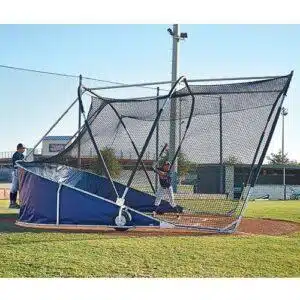
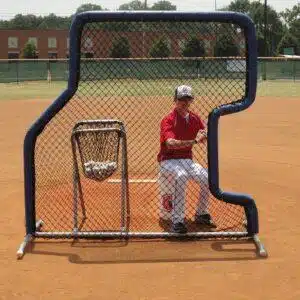
If you want a practice tool that supports these skills at home, the Big Bubba Elite Batting Cage gives you a quality training environment for repetitive hitting work. For pitchers working on command and mechanics, the Pitcher’s Pocket Pitching Target is a focused tool for building accuracy and arm development.
Quick Recap
- Baseball training targets explosive rotational power, not bulk or endurance.
- About 80 percent of energy in baseball comes from the phosphagen system, so sprints and short plyometric bursts are the right cardio tool.
- Hitting and throwing happen in a rotational plane, so core and hip rotation work is essential.
- The shoulder joint faces extreme stress in pitching, making rotator cuff and deceleration training non-negotiable.
- Bat speed training uses the kinetic chain, starting from the legs and moving through the core to the arms.
- Ball velocity training combines strength work with weighted ball and medicine ball progressions.
- Biomechanical video analysis, visual skills training, and mental skills training complete a full baseball program.
- All physical training must be integrated with on-field skill work to be effective.
- Trainers, coaches, and medical staff should collaborate on every player’s program.
Frequently Asked Questions
Do baseball players need to run long distances to stay in shape?
No. Long-distance running does not match the energy demands of baseball. The game is anaerobic and relies on the phosphagen system, so sprints and interval training are the right conditioning tools.
Should baseball players lift heavy weights to build power?
Baseball players should build strength but avoid excess bulk. Training with moderate weights at high speed in rotational movement patterns, along with plyometrics, develops the explosive power the sport requires without adding unhelpful mass.
Why is rotator cuff training so important for pitchers?
Pitching generates an angular velocity approaching 7,000 degrees per second at the shoulder joint. The deceleration phase of the pitch carries the highest injury risk, and the rotator cuff and scapula muscles are responsible for slowing the arm down safely. Specific training for these muscles is essential for injury prevention.
How does core training help bat speed?
The core transfers rotational speed from the lower body to the arms during the swing. When the hips and legs start the movement and the core transfers it efficiently through the kinetic chain, the result is faster bat speed and more power at contact.
What is the kinetic chain principle in baseball?
The kinetic chain is the sequential transfer of force from the legs through the hips, trunk, and arms to the bat or ball. Muscular balance throughout the body is required for this transfer to work efficiently. Weakness at any link in the chain reduces power output and increases injury risk.
Do baseball players need mental skills training?
Yes. Baseball is unique in that failing seven times out of ten is considered Hall of Fame level performance. Players need specific training to handle consistent failure, stay confident, and perform under game pressure. Mental and emotional skills are trained just like physical ones.
How young is too young to start baseball-specific strength training?
Training volume and intensity should always match the athlete’s age and development level. You can find guidance on appropriate training loads in this article on sports training and the young athlete.
About the Author: Charles Slavik is the President of the Eagle Baseball Club in South Elgin, IL. Coach Slavik has helped players maximize athletic performance and avoid injuries by combining 19 years of experience as a youth baseball and softball coach with advanced knowledge of the strength and conditioning field. Slavik is a Certified Personal Trainer by the National Strength and Conditioning Association and a member of the American Baseball Coaches Association.
Ready to put this into practice? Start with the right equipment. The Big Bubba Elite Batting Cage gives you a dedicated space to build bat speed with repetition, and the Pitcher’s Pocket Pitching Target helps pitchers sharpen command and develop arm strength. Pair your gear with a program built by a personal trainer who understands baseball, and explore baseball conditioning techniques to build the complete athlete.