
TL;DR: The right pitching machine depends on your player’s age and skill level, your available space, and your budget. Single-wheel machines work well for beginners and tight budgets, while two-wheel machines give advanced players the full range of pitch types and speeds. A batting cage and an automatic ball feeder make any setup more useful.
What is a pitching machine?
A pitching machine is an electric-powered device that throws baseballs or softballs to a batter at adjustable speeds, replacing the need for a live pitcher during batting practice. Most models run on standard 110-volt power, sit on a tripod or wheeled frame, and can be set for different pitch speeds and directions. They throw either real leather balls or machine-pitch dimple balls, both of which weigh 5 oz.
The two main categories are wheel-type machines (one, two, or three wheels) and arm-style machines. Wheel machines are the most common for backyards, schools, and pro programs. Arm-style machines are built like industrial equipment and are common at commercial batting cages.
You can explore every type available at Baseball Tips pitching machines.
Are pitching machines good for player development?
Yes, pitching machines are one of the single most effective tools a player can use to improve as a hitter, because they deliver consistent, repeatable pitches that let a batter take hundreds of quality swings in one session. A player who has a machine at home and can walk outside and hit any time has a huge advantage over players who rely only on team practice.
Here is how better hitters are built:
- Learn proper mechanics first. Understand how to swing efficiently from pre-pitch to follow-through.
- Repeat those mechanics thousands of times. Quality repetition is the foundation of hitting skill.
- Make small adjustments, then repeat again. The players who improve fastest are the ones who keep showing up.
One coach put it simply when asked if he ever had a player with a backyard machine setup who did not become a much-improved hitter: “No, I don’t think I ever have.” If you can hit, a coach will find a place to play you. Time is the one resource you cannot get back, so you either get the swings or you do not.
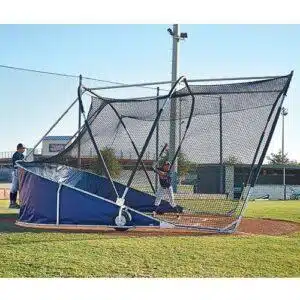
A batting cage makes any machine setup more practical. Most machines also accept automatic ball feeders and remote controls so one player can run a full session alone. See the Big Bubba Batting Cage as one option worth considering.
What pitching machine should I buy?
The pitching machine you should buy comes down to four factors: price, machine type, available space, and who is hitting. For most families, buying a pitching machine is a one-time purchase, so matching those four factors carefully matters more than chasing the lowest price.
Here is a simple way to narrow it down:
- Youth or beginner player, limited budget: A single-wheel machine in the $300 to $700 range throws straight fastballs at 25 to 70 MPH and is plenty for young hitters building fundamentals.
- Intermediate player who wants pitch variety: A single-wheel curveball machine in the $500 to $1,200 range adds a breaking ball without jumping to two-wheel cost.
- Serious or advanced player: A two-wheel machine starting around $1,800 throws every pitch type from both sides of the plate at speeds up to 90-plus MPH.
- Multi-sport household: Most wheel machines can be purchased in a combination baseball and softball package.
- Permanent outdoor backyard setup: An arm-style machine is the most weather-resistant option and never needs to be moved.
If you are torn between two price levels and both fit your budget, keep in mind that more money buys more machine. None of the pitching machines sold at Baseball Tips are low-quality products. You cannot overpay for quality.
How do I pick the right pitching machine for beginners?
For beginners, a single-wheel pitching machine in the $300 to $700 range is the right starting point because it throws consistent straight fastballs at lower speeds, which gives a new hitter time to focus on mechanics rather than reacting to pitch movement. Beginners do not yet need curveballs or high-speed pitches. What they need is thousands of clean, repeatable swings at a speed they can manage.
Key things to look for in a beginner machine:
- Speed range that starts at 25 MPH or lower
- Simple speed control knob
- Tripod mount for stable, consistent pitch location
- Weight under 70 lbs for easy storage or transport
- Compatibility with dimple balls, which are more consistent than leather balls in wheel machines
As the player develops, the machine can be upgraded. Buying a single-wheel beginner machine first is not a wasted investment. It builds the habit of daily swings, which is exactly what a young hitter needs most.
For help getting your setup running smoothly, the pitching machine won’t start emergency fixes guide is a useful resource.
How do I choose a slowpitch machine for batting practice at home?
For slowpitch softball batting practice at home, an arm-style machine set to its lower speed range or a single-wheel machine with a broad speed range starting at 25 MPH is the best fit, because slowpitch arcs require consistent, low-speed delivery rather than the high velocity that two-wheel machines are built for. The entry-level arm-style machine that peaks at 65 MPH also works well for slowpitch softball, even though the arm motion is overhand rather than arc-style.
What to check before buying for slowpitch home use:
- Speed floor: Make sure the machine goes down to 25 MPH or lower.
- Ball compatibility: Confirm the machine accepts 11-inch or 12-inch softballs depending on your league.
- Space: Most machines need at least a full batting cage length. The Big Bubba Batting Cage is one backyard option sized for this.
- One-player operation: An auto feeder lets one person run a full session without a helper feeding balls.
- Power source: All wheel and arm machines run on 110-volt power. If your yard does not have a nearby outlet, a Honda-style inverter works well.
1-wheel vs 2-wheel pitching machine: which is better?
A 2-wheel pitching machine is better for advanced players who need a full range of pitches and higher speeds, while a 1-wheel machine is better for younger or recreational players who need simplicity and a lower price point. The right choice depends on your player’s level and what you need the machine to do.
| Feature | 1-Wheel Machine | 2-Wheel Machine |
|---|---|---|
| Speed range | Approx. 25 to 70 MPH | Approx. 25 to 90-plus MPH |
| Pitch types | Straight fastball (curveball on select models) | Fastball, curveball, slider, changeup, and more |
| Pitch simulation (LH/RH) | Limited or none | Yes, from either side of the plate |
| Ground balls and fly balls | Limited | Yes, including catcher’s pop-ups |
| Weight | Approx. 60 lbs | 60 to 110 lbs |
| Starting price (2026) | A few hundred dollars to approx. $1,000 | Approx. $1,800 and up |
| Best for | Youth, beginners, recreational use | High school, college, advanced players |
| Portability | Easy to transport | Manageable; some models have transport caddies |
Two-wheel machines are the workhorse of pro and college baseball programs. They are the most popular category overall. One newer design worth considering is the Phantom 2-Wheel Pitching Machine, which includes its own transport caddy and is made in the USA. For players who want two-wheel performance at a lower entry cost, the Heater Deuce 2-Wheel Pitching Machine is one of the most affordable two-wheel options available.
One disadvantage shared by all wheel machines is that the batter does not see a pitcher’s arm motion. Players adjust to this quickly, especially when a coach shows the ball to the batter in a consistent rhythm so the hitter can develop timing.
Wheel machines are also less consistent with wet or water-logged balls and seam-swollen balls. Using machine-pitch dimple balls solves this problem.
How do wheel machines compare to arm-style machines?
Arm-style pitching machines differ from wheel machines in that the batter can see the mechanical arm wind up before the pitch, which trains natural timing the same way facing a live pitcher does, while wheel machines deliver the ball from a stationary position that requires a different timing adjustment. Both types have real strengths depending on how and where you plan to use them.
Arm-style machines are the heavy-duty option you see at commercial batting cages. They have been around for over 50 years. They throw a straight, accurate ball at speeds from 25 to 85-plus MPH and can be switched between baseball and softball setups. They come in two feed styles:
- Rack-fed: Holds 38 baseballs or 28 softballs in a rack on the side of the machine.
- Hopper-fed: Holds 600 baseballs or up to 400 softballs, which is ideal for high-volume practice.
Arm-style machines are built like industrial equipment. You can leave them outside year-round. Buying an all-weather cover keeps them looking new for many seasons. Without a cover they will fade and may begin to rust. You almost never need to move them, which makes them ideal for a permanent backyard setup.
One important note on arm-style machines: do not buy a lot of extra parts up front. Spare parts are inexpensive, easy to find, and simple to replace when the time comes. Most people forget where they stored pre-purchased parts before they ever need them.
Wheel machines are a better choice when portability matters, when pitch variety is a priority, or when budget is a primary concern. See all 1, 2, and 3-wheel pitching machines at Baseball Tips to compare every option side by side.
If you run into issues with any machine setup, the pitching machine troubleshooting diagnostic guide covers the most common problems and how to fix them.
Quick Recap
- A pitching machine is the single best training tool a hitter can have at home. Quality repetition builds hitters.
- Your four buying factors are price, machine type, available space, and your player’s level.
- Single-wheel machines are affordable, lightweight, and ideal for youth and beginner players.
- Two-wheel machines throw every pitch type at advanced speeds and are the standard for high school, college, and pro programs.
- Curveball single-wheel models offer a middle-ground option with pitch variety at a lower cost than two-wheel machines.
- Arm-style machines are the toughest, most weather-resistant option and are ideal for permanent outdoor setups.
- All wheel machines perform best with machine-pitch dimple balls rather than wet or seam-swollen leather balls.
- A batting cage and auto ball feeder let one player run a full practice session without help.
- If you can afford either of two price levels, go with the higher one. More money buys more machine.
- Do not stock up on spare parts before you need them. They are easy to find and inexpensive when the time comes.
Frequently Asked Questions
Do pitching machines use real baseballs?
Yes. Real-ball pitching machines throw standard leather baseballs or machine-pitch dimple balls, both of which weigh 5 oz. Dimple balls are recommended for wheel machines because they perform more consistently than leather balls, especially in damp conditions.
How fast does a pitching machine need to be for high school practice?
High school hitters benefit from a machine that reaches at least 70 to 80 MPH. A two-wheel machine, which goes up to 90-plus MPH, gives the most realistic training for that level. Single-wheel machines that top out at 70 MPH are better suited for youth and beginner players.
Can one person operate a pitching machine alone?
Yes. Most pitching machines can be fitted with an automatic ball feeder and a remote control so a single player can load balls, start the machine, and hit without a helper. This is one of the biggest practical advantages of owning your own machine.
Do I need a batting cage with a pitching machine?
A batting cage is not required, but it makes your setup much more useful. Without a cage, many machines end up stored in the garage because retrieving balls after every swing becomes too time-consuming. A cage keeps balls contained and makes practice sessions faster and more efficient.
What is the difference between rack-fed and hopper-fed arm machines?
A rack-fed arm machine holds 38 baseballs or 28 softballs in a rack mounted on the side of the machine. A hopper-fed model holds 600 baseballs or up to 400 softballs in a large container, making it better for high-volume use. Both styles are self-feeding, so no separate auto feeder is needed.
Are two-wheel pitching machines hard to move?
Most two-wheel machines weigh between 60 and 110 lbs, which makes them manageable to transport. Avoid older-technology two-wheel models that weigh 150 lbs, as they are difficult to move and slow to adjust. Newer designs like the Phantom Pitching Machine include a built-in transport caddy for easier handling.
What power source do pitching machines use?
All wheel and arm-style pitching machines run on standard 110-volt AC power. For fields or backyards without a nearby outlet, a quality inverter generator works well as an alternative power source.
Ready to find the right machine for your player? Start at the Baseball Tips pitching machine page to compare every model by type and price. For a broader look at training tools, visit the full baseball training equipment section. If you run into any setup questions, the troubleshooting guide and the emergency fixes guide are there to help. More coaching resources are waiting at the Baseball Tips home page.